Record added successfully


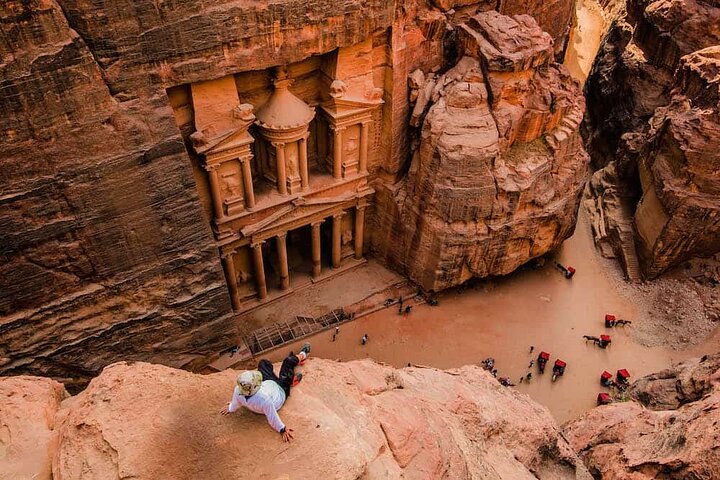
There is a moment every visitor to Petra experiences — the instant you emerge from the narrow shadows of the Siq canyon and the Treasury appears before you, its towering rose-red façade glowing in the desert light. It stops you completely. But to truly understand what you are looking at, you need to understand the remarkable people who created it: the Nabataeans, one of the ancient world's most sophisticated and underestimated civilizations.
The Nabataeans were a nomadic Arab people who, by around the 4th century BCE, had transformed themselves into one of the most prosperous trading nations of the ancient world. Originally semi-nomadic tribes from the Arabian Peninsula, they possessed an extraordinary talent that defined their rise: the ability to find, store, and manage water in one of the harshest desert environments on earth.
Their strategic position between Arabia, Egypt, the Mediterranean, and Mesopotamia placed them at the crossroads of the ancient spice and incense trade. Frankincense from Oman, myrrh from Yemen, silk from China, and spices from India all passed through Nabataean hands. This monopoly over lucrative trade routes generated enormous wealth — and Petra was where that wealth was concentrated, celebrated, and immortalized in stone.
Petra — known in antiquity as Raqmu — sits within a natural basin in the mountains of southern Jordan, surrounded by towering sandstone cliffs that made it extraordinarily defensible. The Nabataeans recognized its potential early, establishing it as their royal capital by around the 3rd century BCE.
At its peak, the city is believed to have housed a population of between 20,000 and 30,000 people. It functioned not merely as a fortress but as a thriving cosmopolitan center, hosting merchants, diplomats, and travelers from across the known world. The Nabataean kingdom stretched from the Hejaz in modern Saudi Arabia northward into the Negev and Sinai, with Petra sitting at its magnificent heart.
What makes the Nabataean civilization so visually breathtaking is what they chose to leave behind. Rather than building upward from the ground, Nabataean craftsmen carved their most important structures directly into the sandstone cliffs — temples, royal tombs, ceremonial halls, and elaborate façades that blended indigenous Arabian aesthetics with Hellenistic and Egyptian influences absorbed through centuries of trade.
The Treasury, or Al-Khazneh, is the most iconic example, likely constructed as a royal tomb in the 1st century BCE. The Street of Façades, the Royal Tombs, the Monastery (Ad-Deir), and the colonnaded street all speak to a culture that was simultaneously deeply rooted in its desert heritage and remarkably open to outside influence. Walking through Petra's archaeological site is, in every sense, walking through a civilization's autobiography written in rock.
Perhaps the most underappreciated achievement of the Nabataean civilization is their hydraulic engineering. In a region receiving barely 100mm of rainfall annually, the Nabataeans constructed an intricate system of channels, cisterns, dams, and terracotta pipes that collected and distributed water across the entire city. This engineering mastery was not incidental — it was the very foundation upon which their civilization was built, and it allowed Petra to sustain a large urban population in an environment that should have made that impossible.
In 106 CE, the Roman Emperor Trajan annexed the Nabataean kingdom, incorporating it into the new Roman province of Arabia Petraea. Petra did not immediately decline — under Roman rule it retained much of its grandeur — but the gradual shift of trade routes away from the overland incense roads, combined with a devastating earthquake in 363 CE, slowly eroded the city's importance. By the Byzantine and early Islamic periods, Petra had been largely abandoned, its extraordinary monuments slowly reclaimed by the desert and forgotten by the wider world.
It was not until 1812 that the Swiss explorer Johann Ludwig Burckhardt, disguised as an Arab traveler, became the first Westerner in modern times to lay eyes on the ruins — rediscovering for the world what the Nabataeans had left behind.
Today, Petra stands as a UNESCO World Heritage Site and one of the New Seven Wonders of the World — recognition that barely scratches the surface of its significance. Ongoing archaeological excavations continue to reveal new layers of Nabataean life, and each discovery deepens our understanding of a civilization that was, by any measure, ahead of its time.
For travelers who want to experience this history not as a fleeting glance but as a genuine immersion, arriving at Petra with context, knowledge, and a dedicated private guide transforms the visit entirely. If you are planning to explore Petra from Amman, the Petra Full Day Trip From Amman offered by Jordan Private Tours provides exactly the kind of personalized experience this remarkable site deserves.
Petra rewards the curious. The more you know about the Nabataeans before you arrive, the more the rose-red city will speak to you — and what it says is extraordinary.
To begin planning your private journey through Jordan's ancient wonders, explore the curated experiences at Jordan Private Tours and let the history lead the way.