Record added successfully


When most travellers think of Roman ruins, their minds jump immediately to Rome, to the Colosseum, the Forum, the Palatine Hill. But tucked away in the green highlands of northern Jordan, about an hour's drive from Amman, lies a city that rivals anything Italy has to offer. Jerash, known in antiquity as Gerasa, is widely regarded by archaeologists and historians as the best preserved Roman city outside Italy — and visiting it is one of the most genuinely awe-inspiring experiences a traveller can have anywhere in the Middle East.
Jerash's story stretches back more than two thousand years. Founded and significantly developed during the height of the Roman Empire, the city flourished as one of the great Decapolis cities — a league of ten powerful Greco-Roman urban centres that shaped the cultural and commercial landscape of the ancient Near East.
What makes Jerash extraordinary is not just its age, but its extraordinary state of preservation. Buried under sand and silt for centuries following an earthquake in the eighth century AD, the city was shielded from the kind of stone robbing and urban development that erased so many other ancient sites. When excavations began in earnest during the nineteenth and twentieth centuries, what emerged was essentially a Roman city largely intact — streets, temples, theatres, colonnaded avenues and monumental arches still standing as they had for nearly two millennia.
No visit to Jerash is complete without standing before Hadrian's Arch, the magnificent triumphal gateway built to honour the Roman Emperor Hadrian on his visit to the city around 129 AD. Standing at nearly thirteen metres tall, it sets the tone for everything that follows beyond it.
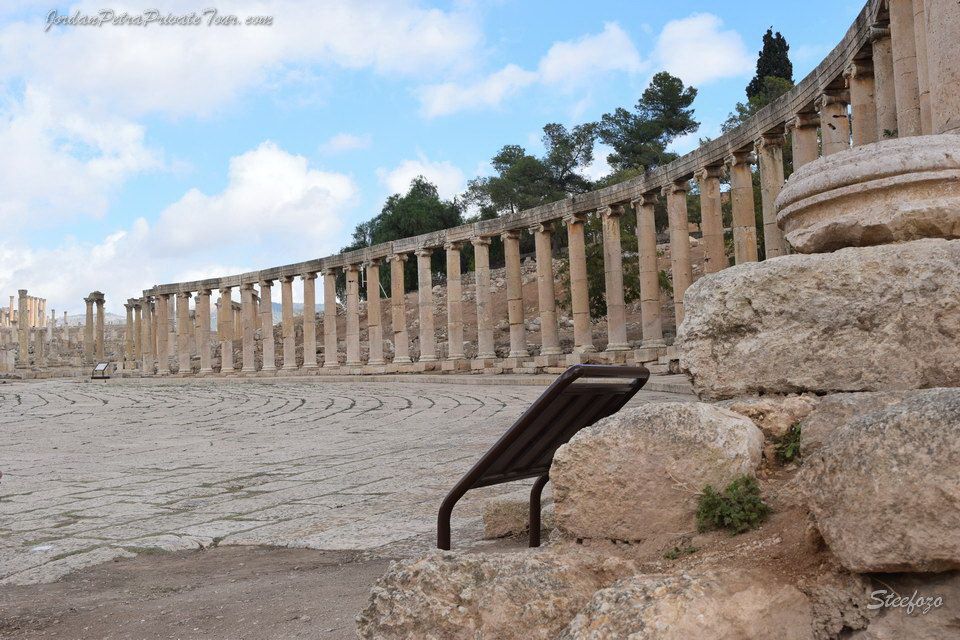
Inside the ancient city walls, the Oval Plaza is one of the most visually striking Roman public spaces anywhere in the world — an elliptical forum ringed by Ionic columns that somehow still manages to convey the grandeur of civic Roman life. From here, the famous Cardo Maximus, the colonnaded main street, stretches northward through the city, its original paving stones still visible, worn smooth by the feet of countless Roman citizens who walked them long before us.
The South Theatre, which once seated up to three thousand spectators, remains so well preserved that it hosts live performances to this day. Temples dedicated to Zeus and Artemis rise from the hilltops on either side, their soaring columns silhouetted against the Jordanian sky in a way that no photograph can entirely capture.
There is something quietly profound about walking the Cardo Maximus at Jerash. The ruts carved into the stone by Roman chariot wheels are still visible between the paving slabs. The column stumps and standing pillars lining either side once sheltered market stalls, workshops and public fountains. For a traveller with even a passing interest in history, it is impossible not to feel the weight of time beneath your feet.
A knowledgeable private guide can bring all of this to life in ways a guidebook never can — connecting the physical remains to the human stories, the politics, the trade routes and the daily rhythms of a city that was once home to tens of thousands of people.
Jerash is not merely an open-air museum. The modern town sits alongside the ancient site, and the region itself is home to a warm and welcoming Jordanian community with its own rich cultural traditions. A visit here, especially as part of a broader journey through northern Jordan, offers a fuller picture of a country that layers ancient history with vibrant contemporary life.
Jerash deserves more than a rushed group tour with a hundred other visitors. Exploring it with a private guide means setting your own pace, asking the questions that interest you, and genuinely absorbing what you are seeing rather than simply moving through it. For travellers combining Jerash with other iconic Jordanian experiences in a single day, the **Amman-Jerash-Dead Sea Full Day Trip** offered by Jordan Private Tours is an excellent way to cover extraordinary ground without sacrificing depth or comfort.
Jerash is best visited in the cooler months between October and April, when the heat is manageable and the light is ideal for photography. Wear comfortable walking shoes — the ancient paving stones are uneven in places — and allow at least two to three hours to do the site justice. Early morning visits offer a quieter, more atmospheric experience before the day-tour crowds arrive.
Jordan is one of the safest and most rewarding destinations in the entire Middle East, and Jerash alone is reason enough to make the journey. Whether you are a dedicated history enthusiast or simply a curious traveller looking for an experience unlike anything else, this ancient city will not disappoint.
To begin planning your private Jordan experience, explore the tailored itineraries and expert guidance available at Jordan Private Tours — where every journey is designed around you.